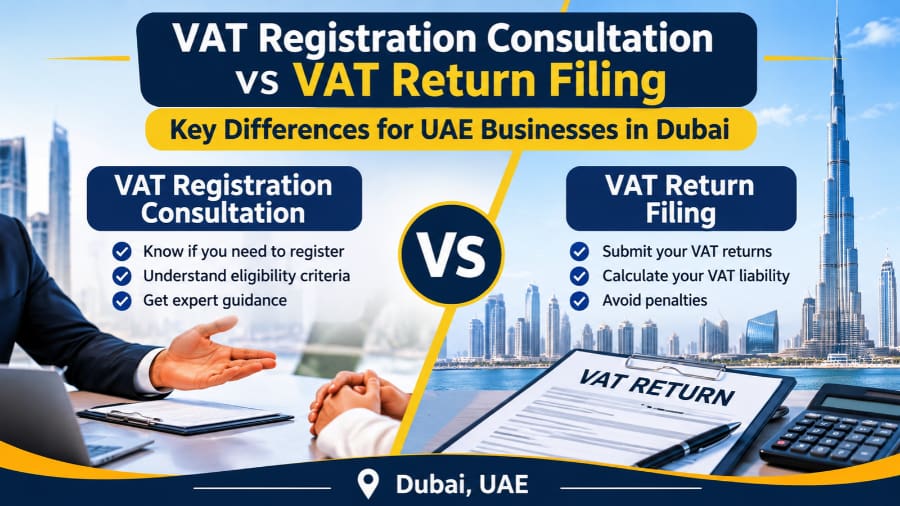
VAT Registration Consultation vs VAT Return Filing: Key Differences for UAE Businesses in Dubai

The comparison of VAT registration consultation vs VAT return filing can help you understand that both are designed to serve different stages of tax compliance with the Federal Tax Authority (FTA) in the UAE.
By confusing VAT registration with VAT return filing, it can result in unnecessary compliance issues for businesses operating in the UAE. VAT registration is registering your business with the Federal Tax Authority (FTA) to obtain a Tax Registration Number (TRN) with professional guidance, whereas VAT return filing is the regular reporting of the VAT collected on sales and paid on purchases. So if businesses treat these as the same requirement, it can lead to missed deadlines for registration or filing, unexpected tax liabilities, and potential penalties.
Table of Contents
Thus, they should understand that registering for VAT does not automatically mean their VAT returns are filed. And they should also know the comparison between VAT registration consultation vs VAT return filing to maintain compliance with the UAE rules.


What is VAT Registration Consultation in the UAE?
VAT registration consultation is a professional advisory service in the UAE that assists businesses with the documentation and other processes involved in the VAT registration process with the Federal Tax Authority (FTA). In addition, the registration process is completed through the official EmaraTax e-services portal.
The services of VAT registration consultation UAE usually include services such as:
- Eligibility Assessment,
- Turnover Evaluation,
- Documentation Guidance,
- Compliance Advice, and
- Registration Assistance.
UAE VAT registration thresholds:
| Registration | Thresholds | Requirement |
| Mandatory VAT Registration | AED 375,000 | Registration is compulsory when taxable supplies and imports exceed AED 375,000. |
| Voluntary VAT Registration | AED 187,500 | Businesses may voluntarily register when taxable supplies and imports exceed AED 187,500. |
Note: The thresholds for VAT registration are calculated based on taxable supplies and imports in the past 12 months or expected in the next 30 days.
What is VAT Return Filing in the UAE?
VAT return filing in the UAE is a mandatory process of time to time reporting of the sales, purchases, output and input tax, and net tax liability by the VAT-registered businesses to the Federal Tax Authority (FTA). It is filed through the official EmaraTax portal using Form VAT 201.
The structure of Form 201:
- Boxes 1 to 8: Report sales and other outputs
- Boxes 9 to 11: Report purchases and recoverable input VAT
- Boxes 12 to 14: Calculate the final VAT payable or refundable
The VAT return filing frequency is determined by how much turnover a business has and the tax period that the FTA has assigned, which can be monthly or quarterly. Also, missing the deadline or failing to file can attract potential penalties.
VAT Registration Consultation vs VAT Return Filing: Key Differences
Understand the difference between VAT registration consultation and VAT return filing:
| Basis | VAT Registration Consultation | VAT Return Filing |
| Purpose | Determines whether a business needs VAT registration | Reports VAT collected and paid to the FTA |
| Applicability | New and growing businesses | VAT-registered businesses |
| Threshold | Mandatory: AED 375,000; Voluntary: AED 187,500 | No turnover threshold once registered |
| Process | Reviews turnover, business activities, and documents | Calculates output VAT and recoverable input VAT |
| Frequency | Generally a one-time process | Monthly or quarterly, as assigned by the FTA |
| Platform | FTA EmaraTax portal | FTA EmaraTax portal (Form 201) |
| Deadline | Generally within 30 days of becoming liable to register | Within 28 days after the tax period ends |
| Key Benefit | Helps businesses meet registration requirements | Ensures ongoing VAT compliance |
VAT Return Filing Deadline in the UAE: What Businesses Should Know
All businesses in the UAE that are registered with VAT are obligated to submit their VAT returns and pay any VAT dues within a timeframe of 20 days after the end of their assigned tax period.
VAT filing deadline in the UAE:
| Filing Frequency | Tax Period | Deadline |
| Quarterly | Every 3 months | Within 28 days after the quarter ends |
| Monthly | Every month | Within 28 days after the month ends |
Pointers that businesses should remember:
- FTA Portal: VAT returns should be submitted through the official EmaraTax portal.
- Payable Deadline: VAT that is payable should be paid within the same 20 days deadline.
- Nil Returns: Businesses are required to file a VAT return even if there are no transactions to report.
- Late Filing: If delays occur in filing, applicable administrative penalties will be applied.
- Record Keeping: Businesses should maintain proper sales invoices, purchase invoices, and accounting records.
According to the UAE Federal Tax Authority (FTA) VAT Returns User Guide 2021, Section 2.1, Tax Period, Page 3, if a due date for the VAT return filing or payment deadline is falling on a weekend or a national holiday, it is extended to the next working day, coming after that day.
Note: Check the latest UAE VAT regulations and FTA guidelines to ensure active tax compliance.
Why Dubai Businesses Need Professional VAT Consultants
The UAE tax regulations are constantly changing and being updated by the Federal Tax Authority (FTA). Updates introduced in 2026 have strengthened requirements for input VAT recovery, supplier verification, and supporting documentation.
However, business owners and entrepreneurs often struggle to stay up to date with such changes while managing their everyday company operations. Here, the best VAT consultants in Dubai, UAE, can help businesses with these changes and maintain accurate tax records to avoid costly compliance mistakes.
In addition, a single incorrect invoice, missed filing deadline, or inaccurate VAT return can lead to potential fines and compliance risks. But when they work with the top VAT consultants in UAE, they get proper guidance in VAT registration, return filing, tax calculations, and complete FTA audit support, which not only saves time but also reduces errors and maintains financial accuracy.
VAT and Corporate Tax: Differences and Why Businesses Need Both Services
Here is a table differentiating between VAT and the Corporate Tax of the UAE:
| Basis | UAE VAT | UAE Corporate Tax |
| Type of Tax | Indirect Tax | Direct Tax |
| Tax Rate | Standard 5% | 0% up to AED 375,000 taxable income and 9% above |
| Applicable On | Taxable goods and services | Taxable business profits |
| Registration | Mandatory above AED 375,000 taxable supplies | Generally required for taxable persons, subject to applicable rules |
| Filing Frequency | Monthly or quarterly | Annually |
| Tax Authority | Federal Tax Authority (FTA) | Federal Tax Authority (FTA) |
| Main Purpose | Collects tax on consumption | Taxes business profits |
Apart from VAT registration and return filing, businesses also need to manage their Corporate Tax (CT) calculations and filing on time. Since VAT and Corporate Tax (CT) also have different registration requirements, filing deadlines, and processes, managing both needs good tax planning and local expertise.
That is why businesses should consider the best corporate tax consultant in Dubai to handle both separately and compliantly.
How HISAB Taskmaster CA Advisors Supports UAE Businesses with VAT Compliance
HISAB Taskmaster CA Advisors is operating as a reputed financial and tax advisory firm in Dubai, UAE. As well-known VAT consultants in Dubai, we have years of experience in offering professional support for VAT registration, return filing, tax calculations, and regulatory compliance.
Our expert team helps you prepare accurate VAT returns, stay updated on filing deadlines, reduce errors in applications, and reduce the risk of penalties.
Services we offer for VAT and Corporate Tax (CT):
- VAT Registration and TRN Issuance
- VAT Return Filing
- FTA VAT Audits Support
- Transaction and Advisory Services
- Accounting and Bookkeeping
- Corporate Tax and Regulatory Services
- Virtual CFO and Financial Planning
Conclusion
VAT registration consultation and VAT return filing are different requirements, and businesses should understand the differences. They should know when to register, what documents to prepare, and when to submit the VAT returns to avoid missing deadlines that can further result in penalties. Apart from this, businesses must also keep themselves updated with the ongoing VAT regulations to maintain compliance and reduce dispute risks with the FTA.
As a UAE business, if you are looking for professional VAT registration and return filing support, you can connect with HISAB Taskmaster CA Advisors. As highly experienced VAT consultants in Dubai, UAE, we offer complete guidance, including documentation, calculation, registration, filing, and other procedures. Thus, reach out to our team today and get complete VAT solutions in Dubai.
Frequently Asked Questions (FAQs)
1. Can I register for VAT in the UAE if my business is newly established?
Yes, a newly established business in the UAE can also register for VAT, depending on its taxable turnover.
2. What happens if my business turnover falls below the VAT registration threshold?
Your business may need to apply for VAT deregistration with the FTA if your taxable business turnover falls below the VAT registration threshold.
3. Can I claim input VAT on business expenses in Dubai?
Yes, you can claim input VAT on business expenses in Dubai.
4. How can I check whether my company is VAT registered in the UAE?
You can use your Tax Registration Number (TRN) and visit the official EmaraTax e-Services portal to check whether your company is registered for VAT.
5. Can I deregister my business from VAT if I stop operating in the UAE?
Yes, you can deregister your business from VAT if you stop operating in the UAE.